How Can Commercial Construction Homer Bring Your Vision to Life?
- James Carter
- Jun 11
- 6 min read

ou have a clear picture in your head. The building, the layout, the way it's supposed to function for your business or your clients. But somewhere between that vision and an actual structure standing on Homer soil, things get complicated fast. Wrong contractor, missed permits, poor site planning — and suddenly your vision is buried under delays, budget overruns, and arguments on a job site. If you're serious about making that project real, understanding how commercial construction Homer actually works — from first conversation to final walkthrough — changes everything.
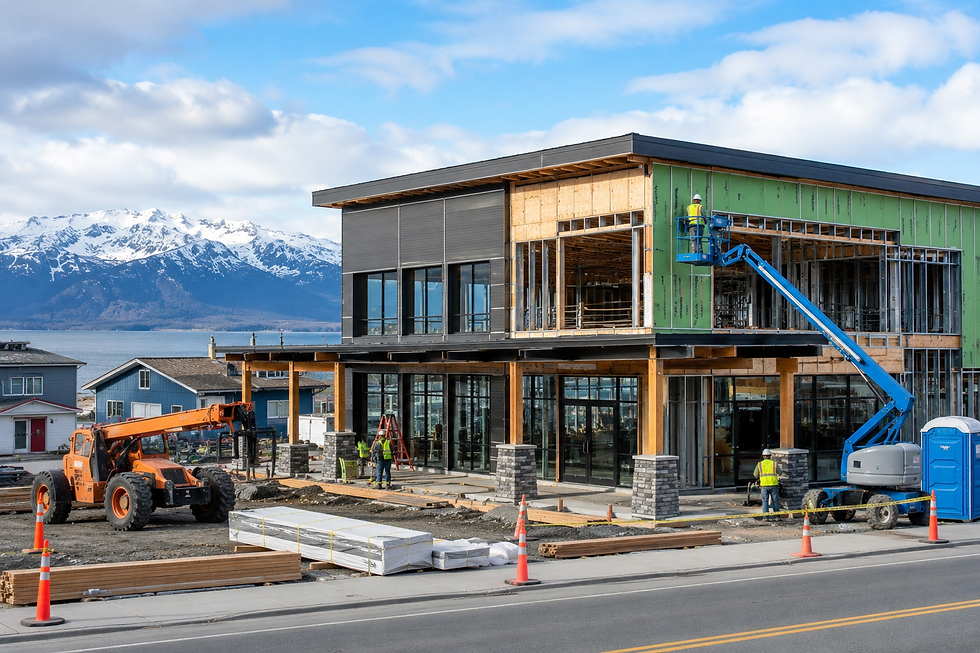
Why Do So Many Commercial Projects in Homer Stall Before They Even Start?
It usually comes down to one thing: the wrong foundation — not in the ground, but in the planning. People come in with a great idea and not enough information about what commercial building in this specific place actually requires.
Homer is not a forgiving environment for shortcuts. The Kenai Peninsula gets real winters. The coastal terrain near the Spit behaves differently than properties further inland on Skyline Drive or East End Road. Frost depth, soil bearing capacity, drainage patterns — these aren't abstract engineering concerns. They're the difference between a building that holds up for decades and one that starts showing problems within the first few years.
The other reason projects stall is hiring someone who says yes to everything upfront. A contractor who doesn't push back during planning, who doesn't ask hard questions about your timeline and site, is not protecting your project — they're just trying to win the bid. And by the time you figure that out, you're already months behind and money is already spent.
What Does It Actually Take to Turn a Commercial Idea Into a Real Building?
More coordination than most people expect, but less mystery than contractors sometimes make it seem.
First, your idea has to become a set of plans — actual architectural and engineering drawings that reflect what you want and what the site can support. Those plans then go through the local permitting process. In Homer, commercial permits run through the Kenai Peninsula Borough, and understanding what that process requires upfront saves you weeks of back-and-forth later.
From there, site prep, foundation, framing, systems, finishes — each phase depends on the one before it being done right. A good commercial construction Homer team manages that sequence tightly, keeps you in the loop, and handles problems before they become expensive.
What you need on your side is a contractor who treats your vision as the north star and builds the entire process around getting you there — not just getting to the next invoice.
How Does Commercial Construction Homer Actually Work Step by Step?
Here's how a well-run commercial project moves from concept to completion:
Step 1 — Vision and Site Assessment Before anything gets drawn or priced, a serious contractor walks the site with you. They look at access, drainage, soil, sun orientation, utility connections, and how the land itself shapes what's buildable. They listen to what you're trying to create and tell you honestly what the site can support. This conversation is where your vision either gets grounded in reality or gets handed back to you with practical adjustments.
Step 2 — Design Coordination and Permitting Working with your architect or design team, your contractor helps translate your vision into construction documents that meet Alaska building codes and local requirements. The Alaska Division of Community and Regional Affairs maintains the adopted building codes for the state — your contractor should know these inside and out. Permits get filed, reviewed, and approved before any ground breaks. Cutting this step short causes problems that don't show up until inspections or resale.
Step 3 — Construction and Site Management This is the longest phase and the one where daily decisions matter most. Foundation poured correctly. Framing square and true. Systems roughed in before walls close. A contractor who runs a tight site keeps your project on schedule, manages subcontractors, and communicates with you regularly — not just when there's a problem.
Step 4 — Inspections, Punch List, and Handoff Before your building is yours to use, it gets inspected. Required inspections aren't bureaucratic inconveniences — they're verification that everything was built to the standard it needs to meet. After inspections pass, a thorough punch list process catches anything incomplete or not quite right. Then the handoff: your contractor walks you through the finished building, explains the systems, and hands over documentation. That's what a complete job looks like.
Why Does Local Knowledge Make Such a Big Difference for Commercial Construction in Homer?
Because Homer has conditions that general contractors from outside the region simply haven't dealt with before.
The ground near Kachemak Bay behaves differently than it does twenty miles inland. Wind loads on the lower Homer Spit are real factors in structural design. The supply chain to the southern Kenai Peninsula requires planning ahead — if a critical material doesn't arrive on schedule, your timeline slips, and a contractor without local relationships can't work around that the way someone established here can.
Local contractors also know the permitting office. They've worked through the Kenai Peninsula Borough process before. They know the inspectors, understand how long each stage realistically takes, and don't pad timelines to cover for unknowns they should already know.
That's not a small thing. On a commercial project, every week of delay has a real cost — to your plans, your financing, your ability to open on the schedule you told your clients or tenants.
Commercial construction Homer done by someone with genuine experience in this specific place is a fundamentally different product than work done by a crew that treats Homer like any other job in any other location.
For those also considering residential work — whether it's a connected project or something separate — the same local expertise applies. The team behind residential construction brings the same place-specific knowledge to homes that good commercial contractors bring to business builds.
Conclusion
Your vision deserves more than a contractor who shows up, does the minimum, and moves on. Commercial construction Homer done right means someone who understood what you were trying to build from day one, managed every phase carefully, and handed you a finished structure that works the way you imagined it would.
That starts with choosing the right team — one with real local roots, a clean process, verified credentials, and a track record of commercial work on the Kenai Peninsula. Don't rush that decision. The build takes months. The building lasts decades.
When you're ready to talk through what you're planning, reach out to Beachy Construction. No pressure, no sales pitch — just a real conversation about your project and whether we're the right fit to bring it to life.
Frequently Asked Questions
How do I know if a contractor has real commercial experience in Homer?
Ask directly — what commercial projects have they completed in Homer or the surrounding Kenai Peninsula? Request references from those specific jobs. Commercial builds are different from residential work, and experience in one doesn't automatically transfer to the other. A contractor confident in their commercial work will have no hesitation showing you what they've built.
What permits are required for commercial construction in Homer AK?
Most commercial builds require a building permit through the Kenai Peninsula Borough, along with additional reviews depending on the project type — electrical, mechanical, plumbing, and sometimes fire suppression. Your contractor should manage this entire process. If they're asking you to figure out permitting on your own, that's a problem.
Can my commercial project be built during an Alaska winter?
Yes, depending on what phase of construction is happening. Experienced contractors in this region plan for winter conditions and know how to protect active work from the elements. It's more demanding than summer building, but it's done regularly when project timelines call for it. The key is having a contractor who has actually done it before.
What should I have ready before talking to a commercial contractor?
A general idea of what you want to build, a sense of the site or location, and any drawings or concept plans you've already developed. You don't need everything figured out — that's partly what the planning process is for. But the more specific you can be about your goals and constraints, the more useful that first conversation will be.
How long does the commercial permitting process take in Homer?
It varies based on project complexity and the Borough's current workload, but plan for several weeks at minimum. More complex projects with multiple system reviews can take longer. A contractor familiar with the local process can give you a realistic estimate upfront and flag anything in your plans likely to slow the review down.


Comments